
NEWS
Temporary Site Security for Utilities and Infrastructure Projects UK
Construction site security is well understood. Event security is increasingly well understood. The security requirements of utilities and infrastructure projects, roadworks, substation upgrades, pipeline installation, telecoms infrastructure, and power distribution works are less often discussed, and the risks are considerably underestimated.
These projects share a characteristic that makes them particularly vulnerable: they place high-value assets in locations that are, by definition, away from existing security infrastructure. A substation upgrade happens in a field. A pipeline installation runs through remote countryside. A telecoms mast installation sits on a hilltop. There are no neighbours watching, no passing foot traffic, and often no mains power, which rules out traditional fixed security systems entirely.
The specific threat landscape for utilities and infrastructure
The risks on utilities and infrastructure sites differ from a conventional construction project in important ways:
In a remote location, the further a site is from population centres, the more time a criminal has to work undetected. A theft that would be interrupted within minutes on a city centre site can continue for hours in a rural location.
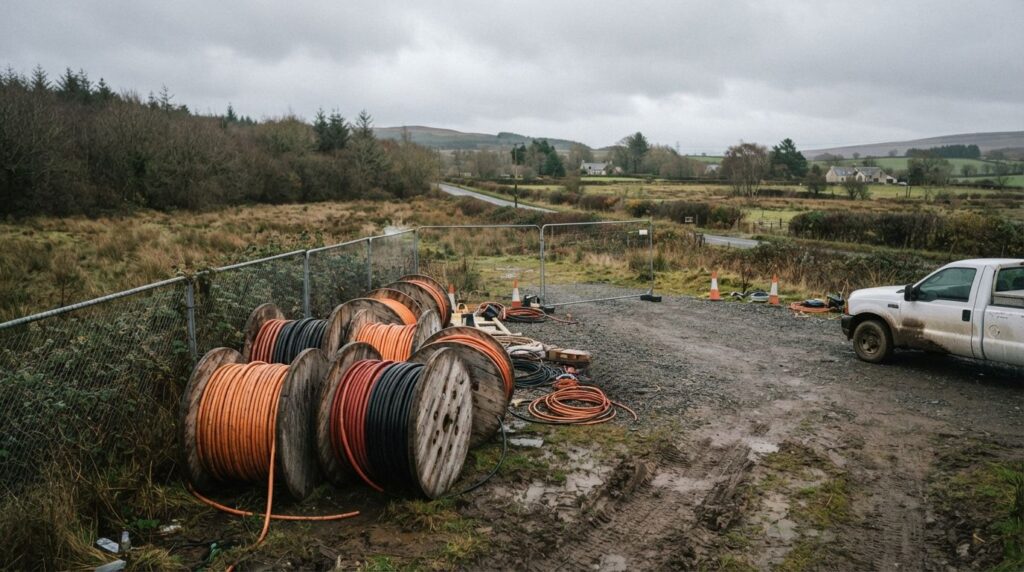
High-value, portable equipment, generators, cable drums, specialist plant, and telecoms equipment all have significant resale value and are specifically targeted by organised theft groups who understand the utilities sector. Cable theft alone costs the UK economy hundreds of millions of pounds annually, and infrastructure projects are a primary target.
Extended project timelines, a substation upgrade or pipeline installation may run for months, with equipment left on site between working periods. Each overnight or weekend period is a window of exposure.
No existing security infrastructure, unlike a commercial property or urban construction site, a remote utilities site has no existing CCTV, no lighting, no alarm system, and no mains power connection to run any of the above. Security has to be entirely self-contained and self-sufficient from day one.
Regulatory exposure, utilities work frequently takes place on or adjacent to critical national infrastructure. A security breach that causes damage to live assets, power cables, gas pipework, or water mains can have consequences that extend far beyond the immediate site and attract regulatory scrutiny from Ofgem, Ofwat, or the HSE.
Why traditional security approaches don’t work on remote sites
The two conventional responses to a site security requirement, manned guarding and fixed CCTV installation, both fail on remote utilities projects for straightforward reasons.
Manned guarding on a remote site is expensive, logistically complex, and raises lone worker safety concerns. A single guard on an isolated rural site overnight is not an adequate security measure; it creates a welfare risk alongside the security one. Multiple guards resolve the welfare issue, but compound the cost problem on a project that may already be running tight margins.
Fixed CCTV installation requires mains power, groundworks, and a fixed infrastructure that is neither practical nor economical on a temporary remote site. The installation lead time is also incompatible with the pace of most utilities projects, where mobilisation can happen faster than a traditional security installation can be scoped and delivered.
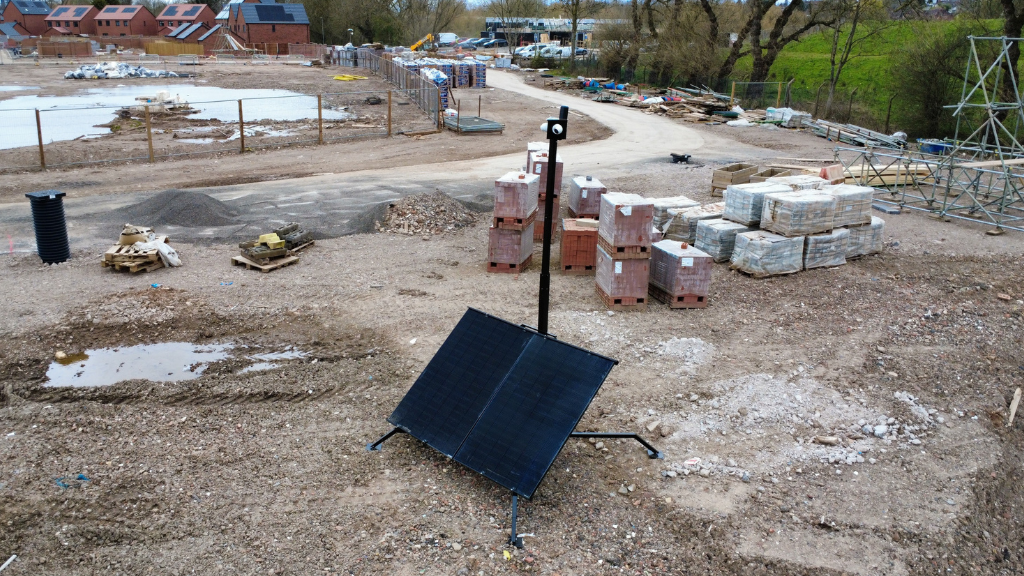
Solar-powered rapid deployment CCTV solves both problems directly. Self-contained units that charge during the day and run through the night on battery power can be deployed on any terrain, anywhere in the UK, without a mains connection, groundworks, or an extended lead time. On-site and operational in under two hours, monitored from the moment they’re commissioned, repositioned as the project footprint moves.
Key coverage priorities on utilities and infrastructure sites
Every project is different, but the areas that consistently represent the highest risk on utilities and infrastructure sites are:
Cable and material storage
Where copper cable, specialist pipework, or other high-value materials are staged for installation, that storage area is the primary target. A CCTV unit positioned to cover the storage compound, with a clear view of all access points and the material itself, is the most impactful single deployment decision on most utilities sites.
Generator and power plant
Generators are a target in their own right, both for theft and for fuel siphoning. On a remote site running a diesel generator for welfare and tool power, an overnight fuel theft can halt the project the following morning. Camera coverage of the generator compound, combined with adequate lighting, significantly reduces this risk.
Plant and vehicle compound
Specialist plant, cable-laying machinery, excavators, and directional drilling equipment are expensive and difficult to replace quickly. Theft of a plant on a utilities project doesn’t just cost the value of the machine; it costs the project programme while a replacement is sourced and mobilised.
Site access points
On a remote site, the access point is often a farm gate or a temporary track opening onto a public road. Covering this point gives you a record of every vehicle entering and leaving, and makes the site visibly monitored from the road, which is itself a significant deterrent.
Solar power, the enabling technology for remote site security
It is worth being specific about why solar and battery hybrid power matters so much in this context, because it is the technology that makes monitored security viable on remote sites at all.
A SkyGuard unit charges its onboard battery bank during daylight hours via integrated solar panels. The battery provides sufficient power to run the camera system, AI detection, siren, speaker, and monitoring transmission through the night, without a generator, without fuel, without noise, and without the maintenance overhead that a diesel power source requires.
In winter months, when daylight hours are shorter, the system’s power management automatically adjusts. And on sites where solar charging is genuinely insufficient, in heavily shaded locations, or in extended periods of low light, supplementary power options are available.
The practical result is a monitored CCTV system that can be deployed anywhere, including locations with no road-accessible power whatsoever.
How SkyGuard can help
SkyGuard provides temporary CCTV and lighting hire for utilities and infrastructure projects across the UK, self-contained, solar-powered, and fully monitored 24/7. Our systems can be deployed on any terrain, at any location, with no mains power requirement. We work around your project programme and can reposition units as the work front moves.
to discuss security coverage for your next utilities or infrastructure project.