
NEWS
What to Expect When You Hire a CCTV Tower: From Enquiry to Installation
For many businesses hiring a CCTV tower for the first time, the process feels opaque. You know you need security, you’ve identified temporary CCTV hire as the right solution, and then, what happens next? How long does it take? What do you need to provide? What does the engineer actually do on-site?
This article walks through the entire process from first contact to a live, monitored system, so you know exactly what to expect at every stage.
Step 1: The initial enquiry
The first conversation is a scoping exercise. A good CCTV hire provider will ask you a small number of straightforward questions to understand what you need:
- Site address: or coordinates for remote locations
- Site type and size: construction site, vacant property, event space, utilities project?
- Primary risk areas: what do you need covered? Compound, perimeter, access point, welfare area?
- Hire period: how long do you need the system? A fixed project timeline, or open-ended?
- Monitoring requirement: 24/7 ARC monitoring is standard with SkyGuard; confirm keyholder details at this stage
- Access arrangements: how does the engineer get on-site, and when?
This conversation typically takes ten to fifteen minutes. By the end of it, the provider should be able to confirm availability, give you a clear quote, and propose an installation date.

Step 2: The quote and agreement
Following the scoping call, you’ll receive a quote covering the hire cost, installation, monitoring, and any redeployment terms. Read this carefully and confirm:
- Is 24/7 ARC monitoring included, or priced separately?
- Is installation and commissioning included in the quoted price?
- Are redeployment visits included, or charged per callout?
- What is the minimum hire period, and what notice is required to end the hire?
- What happens at the end of the hire? Is the collection included?
A transparent provider will answer all of these clearly in the quote document. If any of these points are vague, ask before you sign.
Step 3: Pre-installation preparation
Once the hire is confirmed, there is very little you need to do to prepare the site. Unlike a fixed CCTV installation, a rapid deployment system requires no groundworks, no mains power connection, and no advance preparation of the installation point.
What is useful to have ready:
- Clear access to the proposed installation position, remove any obstruction that would prevent the engineer from positioning the tower base
- Confirmed keyholder details for the monitoring contract, name and mobile number of at least two keyholders reachable out of hours
- A rough indication of camera direction, if you have a specific area you need covered, knowing which way the tower should face saves time on site
That’s it. The engineer handles everything else.
Step 4: Installation day
On the day of installation, a qualified SkyGuard engineer arrives at the agreed time with the fully specified tower unit. The installation process follows a consistent sequence:
Positioning, the engineer assesses the agreed location and confirms the optimal position for coverage. If site conditions have changed since the scoping call, new structures, or different ground conditions, they’ll adjust accordingly and confirm the final position with you.
Base deployment: the tower base is positioned and stabilised. SkyGuard’s anti-tip base plate design is stable on uneven and soft ground without the need for concrete foundations or ballast.
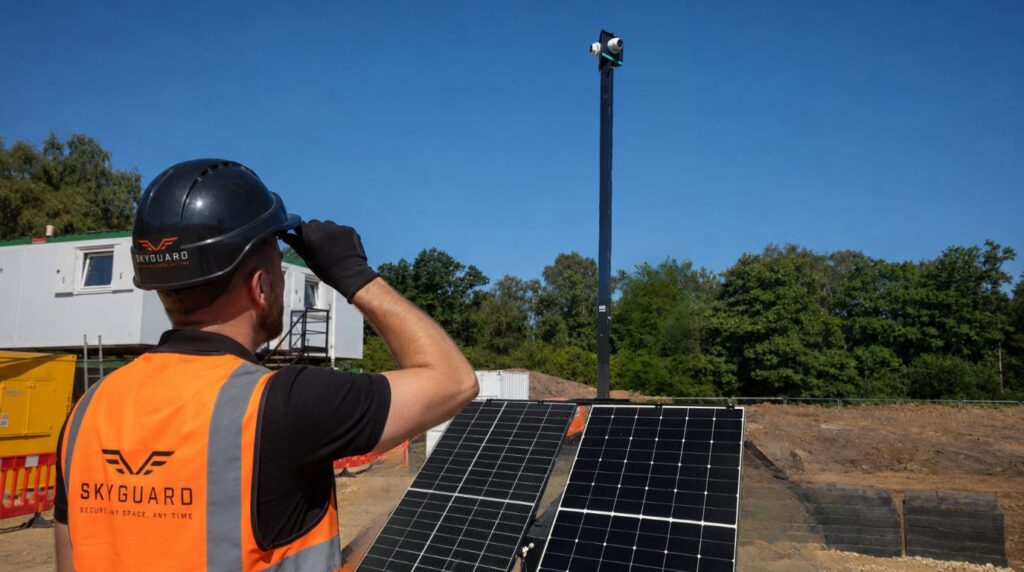
Tower erection and camera commissioning, the tower is erected, the camera head positioned, and the system powered up. The solar panels begin charging the battery bank immediately.
Monitoring connection, the system connects to the ARC monitoring centre, and the operator confirms receipt of the feed. The keyholder list is registered, and the monitoring contract goes live from this point.
Handover, the engineer walks you through what’s been installed, confirms the monitoring is active, and provides contact details for the monitoring centre and for any operational queries. The whole process, from the engineer arriving on site to a live, monitored system, takes under two hours in the vast majority of cases.
Step 5: Ongoing monitoring and redeployment
Once the system is live, the monitoring centre handles alerts in real time. You’ll receive incident reports after any activation, timestamped, with footage reference, and a record of the action taken by the operator.
If your site footprint changes, a new phase begins, and a different area becomes the priority, contact SkyGuard to arrange a redeployment visit. The tower is repositioned, the camera angle confirmed, and the monitoring continues uninterrupted.
Step 6: End of hire and collection
When your project ends or the hire period is complete, contact SkyGuard to arrange collection. The engineer recovers the tower, the monitoring contract closes, and you receive a final incident log for your records, useful for insurance documentation and project file purposes.
The entire lifecycle, from enquiry to collection, is designed to require as little of your time as possible, while keeping you informed at every stage.
to start the process for your next site.