
NEWS
Event Security Hire UK: Protecting Temporary and Outdoor Events in 2026
Running an outdoor event in the UK involves a significant amount of planning, licensing, logistics, catering, and production. Security is often the element that gets addressed last and most briefly. That’s understandable when you’re managing a hundred moving parts, but it’s also the element most likely to create serious problems if it’s underspecified.
From a weekend festival to a corporate outdoor event, a temporary market to a sporting fixture, the security requirements are real, and the consequences of getting them wrong range from equipment theft to a public liability claim that dwarfs the cost of any security measure you could have taken.
This article covers what event security actually involves in 2026, where the gaps most commonly appear, and how temporary CCTV hire fills those gaps quickly and cost-effectively.
The specific risks at temporary events
Events create a security profile that is different from a construction site or vacant property; the risks are more varied, the timeline is compressed, and the public-facing nature of the event adds complexity.
The most common security issues at UK outdoor events include:
Equipment and asset theft, generators, production equipment, catering kit, and temporary structures represent significant value, and the open nature of event sites makes them accessible to opportunistic thieves, particularly overnight between event days.
Perimeter breaches, ticketed events lose revenue when perimeter integrity fails; unlicensed events face licensing consequences; and any event faces liability exposure if unauthorised individuals gain access to restricted areas.
Vehicle and plant theft, events often have significant plant on site during setup and breakdown, forklifts, MEWPs, and towing vehicles that are left unattended overnight.
Public safety incidents, crowd management, access control, and emergency response all require a security infrastructure that is planned in advance, not improvised on the day.
Post-event vulnerability, the period between the event ending and full site clearance, is often the highest-risk window; equipment is staged for collection, site staffing is reduced, and the perimeter is at its most compromised.
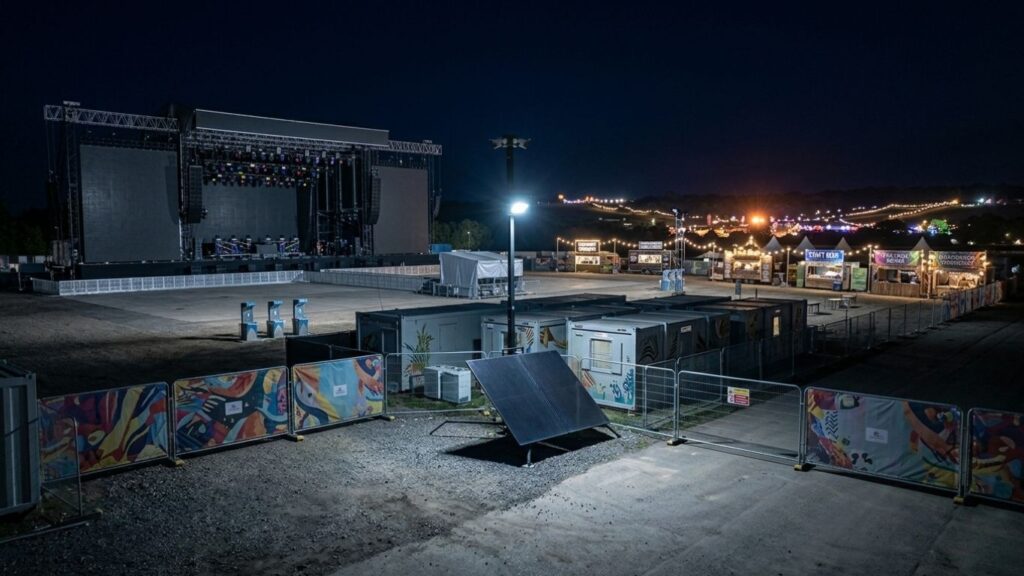
What a temporary event security system looks like
A well-specified event security setup using hired CCTV and lighting systems covers three phases: setup, live event, and breakdown.
Setup phase
Before a single member of the public arrives, the site already contains significant assets, staging, power infrastructure, catering equipment, and production kit. CCTV coverage during setup protects those assets and monitors site access during a period when large numbers of contractors are moving through the site with legitimate reasons to be there, which makes unauthorised access harder to spot without camera coverage.
Live event
During the event itself, fixed and mobile camera coverage serves multiple purposes:
- Perimeter monitoring, detecting and deterring breaches at fence lines and access points
- Asset protection, covering backstage, production, and hospitality areas that are restricted to authorised personnel
- Public safety support, providing event management with situational awareness across large areas
- Evidence capture, timestamped footage that supports incident investigations and insurance claims if something goes wrong
Breakdown and post-event
The highest-risk window. Kit is being packed down, site staffing drops, and the perimeter is often partially dismantled. Maintaining CCTV coverage and lighting through the full breakdown period, until the last item of equipment has left the site, closes the gap that is most frequently exploited.
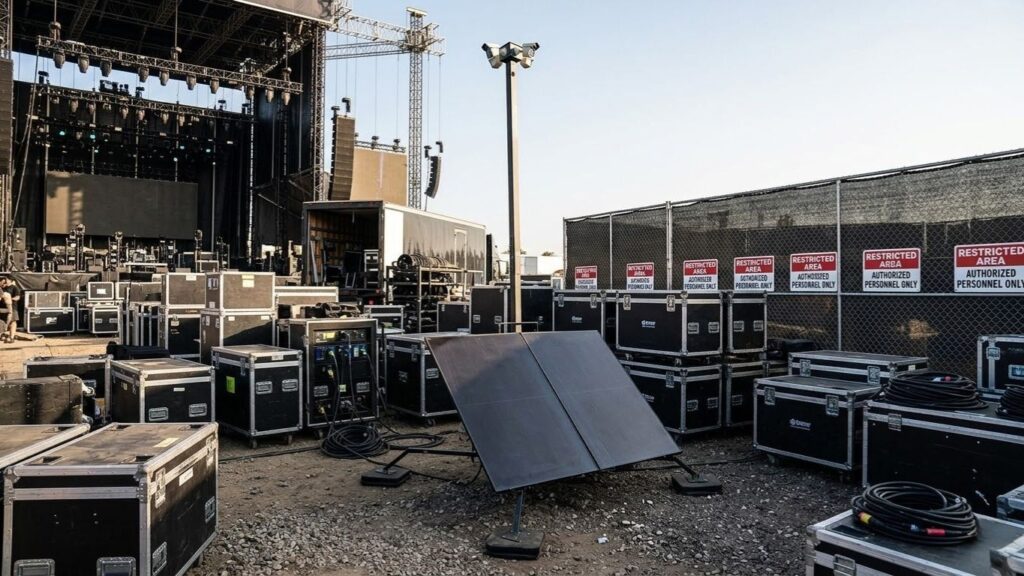
Why hire rather than purchase
For most event organisers, the answer is straightforward: events are temporary, and security equipment shouldn’t outlast the event it was deployed for.
Purchasing CCTV towers, lighting units, and monitoring infrastructure for a single event, or even a season of events, involves capital expenditure, storage, maintenance, and the operational challenge of deploying and recovering equipment across multiple locations. For an organisation whose core business is running events, not security, that is a significant distraction.
Hiring from SkyGuard means:
- Equipment arrives specified for your event, the right number of units, positioned for your specific site layout
- Professional installation in under two hours per unit, no groundworks, no mains connection required
- 24/7 ARC monitoring is active from the moment the system is commissioned
- Collection arranged at the end of the hire period, no storage, no maintenance, no logistics headache
- Scalable, additional units can be added if the site expands or a new risk area is identified during setup
Licensing, insurance and your legal position
Events in the UK operate under a licensing framework, the Licensing Act 2003 for events involving regulated entertainment or alcohol, and licence conditions frequently include security requirements. Failing to meet those requirements is not just a compliance issue; it puts your licence at risk.
From an insurance perspective, public liability cover for events is closely tied to the security measures in place. An insurer assessing a claim arising from a public safety incident or an asset theft will examine the security specification in detail. Documented, monitored CCTV coverage strengthens your position considerably.
How SkyGuard can help
SkyGuard provides temporary CCTV and lighting hire for events across the UK, from single-day corporate gatherings to multi-day festivals. Our systems are self-contained, rapid to deploy, and monitored 24/7 from a staffed ARC. We work around your event schedule and can be on site during setup, live across the event, and recovered during breakdown.
to discuss security hire for your next event.