
NEWS
Vacant Property Security UK: How to Protect Empty Buildings
Empty buildings attract problems. It’s not a prejudice; it’s a pattern that insurers, police forces, and property managers recognise consistently. An unoccupied commercial property, a stalled development, a building between tenants, or a site awaiting planning consent all share the same vulnerability: no legitimate activity, reduced oversight, and assets that are easier to access than they should be.
The consequences range from nuisance, fly-tipping, graffiti, squatting, to genuinely serious: metal theft, structural damage from arson, and the kind of insurance claims that make renewal conversations extremely difficult.
This guide covers the risk landscape for vacant properties in the UK in 2026, what the law requires of property owners and managers, and how temporary CCTV hire provides fast, cost-effective protection for the gap between occupancy.
Why are vacant properties so frequently targeted?
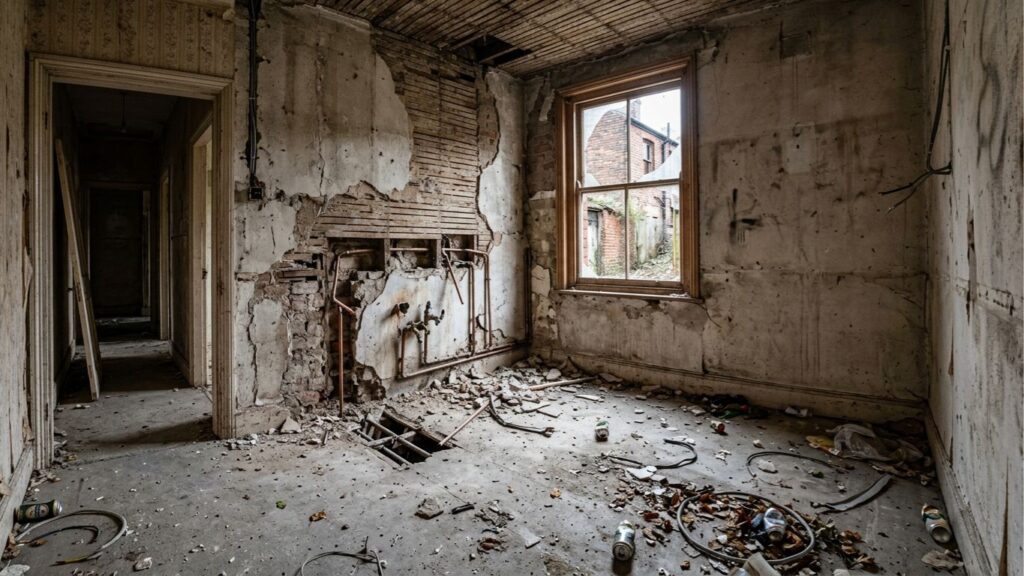
A building with people in it has natural deterrents: activity, noise, lighting, comings and goings. Remove all of that, and the risk profile changes dramatically. Organised crime groups that target vacant properties do so because the risk-to-reward calculation is favourable, no witnesses, extended windows of time to work, and assets (copper pipework, lead flashing, electrical cable, HVAC equipment) that have immediate resale value.
The most common threats to vacant properties in the UK include:
- Metal theft — copper pipework, lead roofing, electrical cable and aluminium are stripped methodically, often causing damage far exceeding the value of what was taken
- Arson — both deliberate (insurance fraud, targeted) and opportunistic (rough sleepers, vandals); a leading cause of total loss in vacant commercial properties
- Squatting and unauthorised occupation — particularly in urban areas; once established, removal is legally complex and costly
- Vandalism and fly-tipping — lower value individually but cumulatively damaging and a signal to more serious criminals that the property is truly unmonitored
- Plant and equipment theft — where a building contains retained plant, kitchen equipment, or other removable assets
What the law requires of vacant property owners
Property owners and managers have legal obligations that do not pause when a building becomes empty. The key areas are:
Insurance conditions
Most commercial property insurance policies contain specific conditions around vacant properties, typically requiring notification to the insurer within 30 days of the property becoming unoccupied, and imposing minimum security requirements as a condition of continued cover. Failing to meet these conditions can result in a claim being declined, even if the policy is technically active.
Common insurer requirements for vacant properties include:
- All ground-floor windows and doors are secured to a specified standard
- All services are isolated where practical
- Regular inspection visits (typically weekly or fortnightly), documented in writing
- Adequate security measures, which increasingly means monitored CCTV, not just locks and boarding
Regulatory Reform (Fire Safety) Order 2005
Fire safety obligations do not end with occupancy. A vacant building that poses a fire risk to neighbouring properties or to people who may gain unauthorised access (including squatters) still falls within the scope of the RRO. A fire risk assessment should be reviewed on vacancy and appropriate measures maintained.
Public liability
If an unauthorised visitor is injured on your vacant property, a child who climbs through a broken fence, for example, the property owner can face liability claims. Maintaining adequate security is part of discharging the duty of care.

Why temporary CCTV hire is the right solution for vacant properties
Purchasing and installing a permanent CCTV system in a building that may be occupied, sold, or demolished within months is rarely the right financial decision. The cost is hard to justify, the equipment is tied to a building you want to move on from, and installation often requires work that is not appropriate for a property in flux.
Temporary CCTV tower hire solves this cleanly:
- Deployed in hours — a monitored system can be operational on the day you need it, with no groundworks or fixed installation required
- No capital expenditure — hire costs are operational, directly attributable to the vacant period, and end when occupancy resumes
- Fully monitored — not just recording, but active 24/7 ARC monitoring with verified response to alerts
- Satisfies insurer requirements — a monitored CCTV hire system, documented in writing, meets the security conditions most insurers apply to vacant commercial properties
- Flexible hire period — whether the vacancy lasts three weeks or eighteen months, the hire period matches exactly
The monitoring advantage
A key distinction that matters particularly for vacant properties: the difference between a system that records and a system that is actively monitored.
A recording-only system captures what happens after the fact. It may help with an insurance claim or a police report. It does not prevent metal theft, arson, or the damage.
A 24/7 staffed ARC monitoring contract means that when an intruder enters the property, an operator is notified within seconds, issues a live audio challenge through the tower’s speaker system, and escalates to keyholders and police with verified footage. That is the difference between documenting a crime and preventing one.
A practical security checklist for vacant property managers
Before leaving a property vacant, work through the following:
- Notify your insurer in writing and confirm the conditions of continued cover
- Review your fire risk assessment — update it to reflect the vacant status
- Secure all access points to the standard your insurer requires
- Isolate utilities where practical — water, gas, and non-essential electrical circuits
- Remove or secure any retained assets of value — plant, equipment, fittings
- Arrange monitored CCTV coverage — confirm 24/7 ARC monitoring, not recording only
- Set up a documented inspection schedule — weekly or fortnightly visits, written log
- Register keyholders with your monitoring provider — a minimum of two, reachable out of hours
- Inform your local police safer neighbourhood team — many forces offer advisory visits for vacant commercial properties
How SkyGuard can help
SkyGuard provides temporary CCTV hire for vacant properties across the UK, fully monitored, fast to deploy, and specified to meet the security conditions your insurer requires. Our systems are self-contained, solar-powered, and require no fixed installation, making them ideal for properties in any condition and at any stage of vacancy.
to discuss coverage for your vacant property and get a hire quote.